Solution architecture
The StarkWare services are composed of the following components:
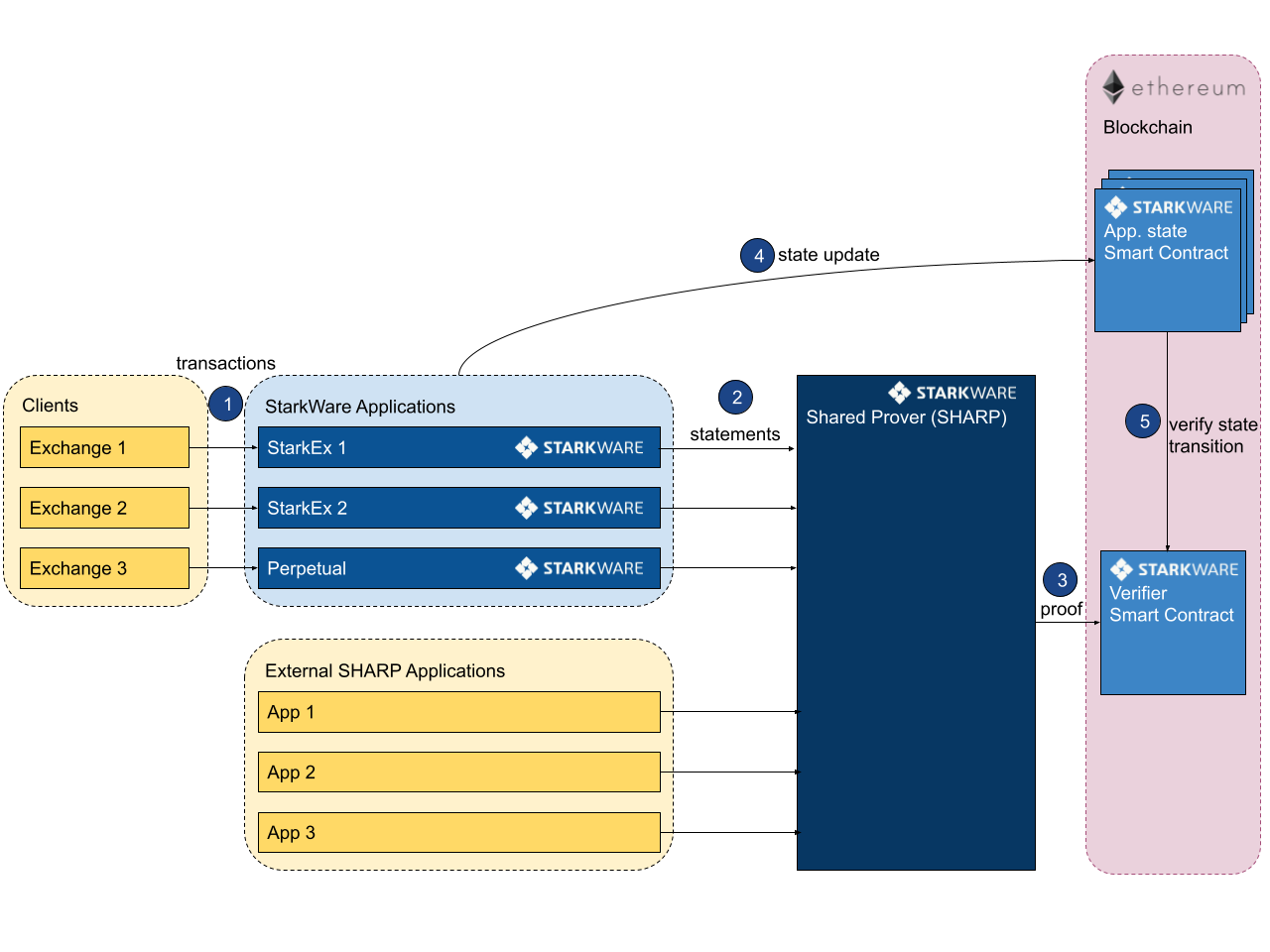
Shared Prover (SHARP) and Verifier
The Shared Prover, SHARP provides the infrastructure to support scalable applications. SHARP generates proofs to computational integrity statements. These proofs are submitted on-chain to the Verifier smart contract. The Verifier smart contract then stores the hash of every valid statement in a dedicated Fact Registry.
Applications
SHARP and the Verifier smart contract provide a service developed and maintained by StarkWare to serve customers according to their dedicated logic, such as supporting an Exchange.
The state achieved by a customer’s application is committed on the application’s dedicated Ethereum-based smart contract.
|
Typically, only the hash of the state is kept on-chain. To enforce the trustless nature of the system, the on-chain state can only be updated by a proof attesting to the validity of the state transition. StarkWare’s SHARP provides this proof. |
At a high-level, StarkWare applications do the following:
-
Process Requests
StarkWare applications process customer requests, transform these transactions into provable statements, and send these to SHARP. All via an intuitive customer API (step 1 in the diagram).
Typically, several requests are batched together into a single statement (step 2 in the diagram). For example, a batch can compile 1000 financial transactions to be sent for proving.
-
Prove with SHARP
SHARP constructs the proof.
-
Register the Proof
SHARP transmits the proof to the on-chain Verifier smart contract (step 3 in the diagram).
-
Register the State Transition
StarkWare applications then apply the state transition on the customer application’s smart contract (step 4 in the diagram).
To ensure the transition’s validity (i.e., that SHARP verified it), the customer application’s smart contract corroborates that the transition statement is registered in the Verifier smart contract (step 5 in the diagram).